
Farmhouse Fruit Orchard: Planning Your Planting
How to plan a farmhouse fruit orchard: choosing mango, guava and lemon, spacing, pit preparation, grafted saplings, drip irrigation, fencing and early care.
By Rajput Farms · 2026-11-02
A farmhouse fruit orchard does well when you plan it before planting: choose fruit trees that suit your climate and soil, mark the layout with proper spacing, dig and fill pits ahead of time, plant healthy grafted saplings, and lay drip irrigation and fencing first. The first two years of care decide how the orchard performs.
Why a farmhouse orchard needs a plan
Many owners plant fruit trees wherever there is space, then find a few years later that they shade the lawn, crowd each other or block the driveway. Fruit trees live for decades, so farmhouse orchard development starts with a few questions: is the orchard for home use, for looks or for selling some produce, how much land can it take, and who will look after it on weekdays? The answers decide how many trees you plant, which fruits you choose and how much automation you need.
Step 1: Choose fruits that suit your land
In the plains of Uttar Pradesh and the Delhi-NCR region, mango, guava and lemon are among the most common choices for a farmhouse, and each behaves differently:
- Mango becomes a large, long-lived tree with a wide canopy. It needs plenty of space and full sun, and young trees are sensitive to frost in the first few winters. A mango orchard for a farmhouse is usually planned as the backbone of the layout.
- Guava is a medium-sized, hardy tree that tolerates a range of soils and starts bearing earlier than mango. A small guava plantation for a farmhouse is a popular choice for home use.
- Lemon and other citrus stay smaller, suit a corner near the kitchen garden or house, and dislike waterlogged soil. Our lemon plantation page covers citrus orchards.
Jamun, amla, ber or papaya can add variety, but keep the main block simple: too many species are harder to water, feed and protect. Our fruit tree plantation service covers fruit-bearing trees more broadly.
Step 2: Check soil, water and drainage
Fruit trees dislike standing water around their roots, so avoid low spots where rain collects, or use raised mounds and shallow drains on flat, heavy land. A basic soil test shows pH and salinity; many farm soils in north India are alkaline or salty in patches, and citrus reacts badly to this. Check borewell yield and water quality too, since both affect the irrigation design.
Step 3: Plan the layout and spacing
Spacing is where most farmhouse orchards go wrong. Saplings look small, so owners plant them close, and within a few years the canopies touch and fruiting drops. Traditional mango planting uses wide spacing, while guava and citrus can go closer. High-density systems exist for mango and guava but need regular, skilled pruning. Ask your sapling supplier for the spacing that suits each variety.
A few layout points that suit farmhouses:
- Keep big trees away from the house, walls and septic tanks. Mango roots and canopies spread wide.
- Put large trees on the north or west side of lawns and seating areas where their shade is welcome, not where it will kill the grass.
- Plant in straight rows or a grid so drip lines, mowing and spraying are simple.
- Leave a service path wide enough for a small vehicle or trolley.
- Use the boundary. A row of fruit trees inside the fence line can double as a green screen.
If you are also building a lawn, plan both together. Our guide to farmhouse lawn development explains why grass struggles under dense tree shade.
Step 4: Prepare pits before planting
Dig planting pits a few weeks before the saplings arrive. Larger trees such as mango get bigger pits than citrus. Keep the topsoil separate from the subsoil, let the open pits weather in the sun for a while, then refill them with the topsoil mixed with well-rotted farmyard manure or compost.
Water the filled pits so the soil settles before planting, or saplings tilt after the first heavy watering.
Step 5: Buy healthy grafted saplings
For mango, guava and lemon, grafted saplings are usually preferred over seedlings. A grafted plant carries the known variety, is more uniform, and generally starts fruiting earlier than a tree grown from seed.
When choosing saplings, look for:
- A healthy, clearly healed graft joint, with no cracks or wrapping cutting into the stem.
- Green, pest-free leaves and a firm root ball that does not fall apart.
- The variety name, so you know what fruit and tree size to expect.
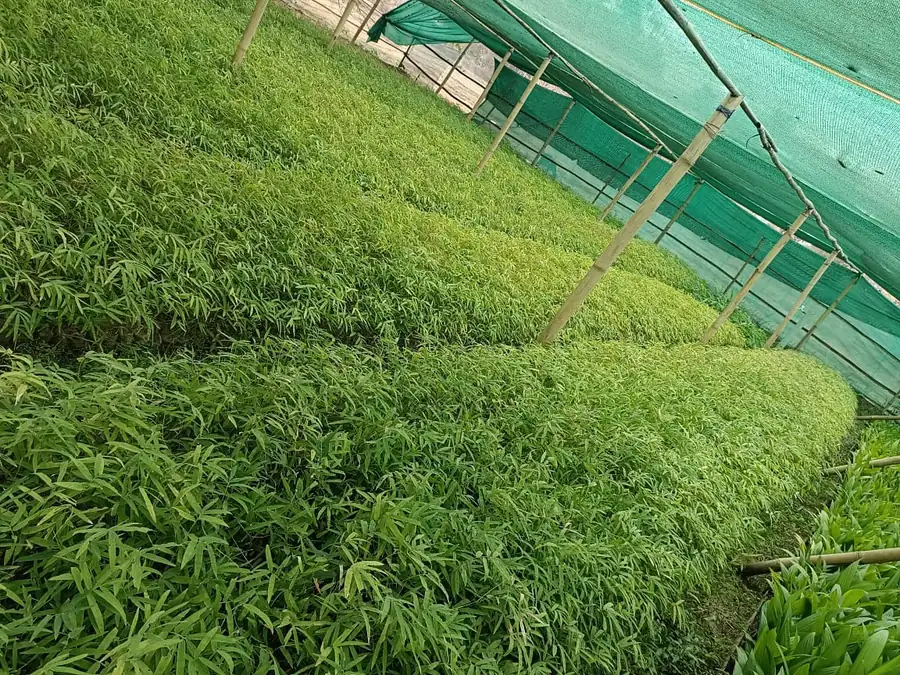
Rajput Farms supplies grafted mango, guava and lemon saplings through its plantation saplings range, and runs its own nurseries, including the Chakeri nursery in Kanpur.
Step 6: Plant at the right time
In north India, the main planting windows for fruit trees are the monsoon (once regular rains have set in) and spring. Peak summer heat and the coldest winter weeks are hard on young saplings. Early winter is a good time to plan the layout, test the soil, dig pits, lay irrigation and build the fence, so everything is ready when the planting season starts.
Plant each sapling at its nursery depth with the graft joint above the soil, firm it in, water deeply and stake it if needed.
Step 7: Irrigation and protection
Drip irrigation suits a farmhouse orchard well. It puts water at the root zone of each tree, saves water compared with flooding, and can run on a timer when nobody is on site. Plan it as a separate zone from any lawn sprinklers, and add drippers as the trees grow. Our drip irrigation page explains how such systems are laid.
Young trees also need protection:
- Fencing. Stray cattle, nilgai and goats can strip a young orchard in one night. A proper farm fence around the orchard or the whole plot is often the first thing to build.
- Frost and sun. Cover young mango saplings on the coldest nights of their first winters, and shade them from harsh afternoon sun in their first summer.
- Mulch. Dry leaves or straw around the base keep moisture in and weeds down.
The first two years of care
A simple routine covers most needs:
- Water regularly, deeper and less often as roots spread.
- Remove weeds from the basin around each tree.
- Shape young trees by light pruning so they form a strong framework of branches.
- Feed with compost or manure and a balanced fertiliser in the growing season, based on advice for your soil.
- Check leaves regularly for pests and disease and act early.
If you will not be on site often, a plantation maintenance arrangement keeps watering, weeding and pruning on schedule.
How Rajput Farms can help
Rajput Farms & Green Infra Pvt. Ltd. has worked in plantation, landscaping and horticulture since the 1980s (40+ years). Its orchard development service covers planning and plantation of fruit orchards, with listed service areas including Kanpur, Varanasi, Gurugram and Delhi-NCR. An orchard can also be planned as part of wider farmhouse landscaping or full farmhouse development. Pricing is quoted per project after understanding the site; no fixed prices are published online.
Frequently asked questions
Which fruit trees are good for a farmhouse orchard in Uttar Pradesh?
Mango, guava and lemon are among the most common choices in the UP plains. Mango gives a large, long-lived shade and fruit tree, guava is hardy and bears earlier, and lemon suits smaller spaces. Choose based on space, soil and how much care the orchard will get.
When should you plant fruit trees at a farmhouse?
In north India, the usual planting windows are the monsoon, once regular rains have set in, and spring. Use early winter to plan the layout, test soil, dig pits, lay drip irrigation and build fencing so planting can start on time.
Should I plant grafted saplings or seedlings?
For mango, guava and lemon, grafted saplings are usually preferred. They carry a known variety, grow more uniformly and generally start fruiting earlier than seedlings. Check that the graft joint is healthy and the variety is named.
Is drip irrigation necessary for a farmhouse orchard?
It is not the only option, but drip suits most farmhouse orchards. It waters each tree at the root zone, saves water compared with flooding, and can run on a timer when nobody is on site. Keep it on a separate zone from lawn sprinklers.
Does Rajput Farms develop fruit orchards for farmhouses?
Yes. Rajput Farms offers orchard development, mango, guava and lemon plantation, fruit tree plantation and plantation maintenance, and supplies grafted mango, guava and lemon saplings. Listed service areas include Kanpur, Varanasi, Gurugram and Delhi-NCR. Call or WhatsApp +91 88087 69257; pricing is quoted per project.
Plan your farmhouse orchard
Share your farmhouse location, approximate area for the orchard, water source and the fruits you would like through the contact page. For orchard development, sapling supply and farmhouse projects, call or WhatsApp +91 88087 69257.