
Government Building Landscaping: Entrances That Stay Green
How to plan government building landscaping: entrance planters, shade-tolerant plants, watering, a maintenance plan and a clear brief for your contractor.
By Rajput Farms · 2026-10-22
Government building landscaping holds up when it is planned around daily use: a clear, tidy entrance, hardy plants in sturdy planters, simple watering and a fixed upkeep schedule. Start with the entrance and driveway, choose plants that tolerate heat, dust and shade under porches, and agree maintenance before planting.
Why entrances matter most in government building landscaping
A government office, tax building, court complex or departmental campus is visited by hundreds of people who mostly see one thing: the entrance. The gate, the driveway, the porch and the steps set the first impression, so this is where green work gives the most visible result for the effort.
Entrances also face practical limits. Porches are often covered, so plants get less direct sun. Floors are paved or stone, so there is no open soil. Footfall is heavy, security staff need clear sightlines, and vehicles stop close to the steps. Good office entrance landscaping works within these limits instead of fighting them.
Start with a short site study
Before choosing a single plant, walk the site and note:
- Light: which spots get full sun, which are under a porch or canopy, and which stay in shade most of the day.
- Hard surfaces: where you have pavers, stone or tiles, and where there is open soil for beds or a lawn.
- Movement: the vehicle drop-off, pedestrian paths, ramps, queues at reception and the guard post. Plants must not narrow these.
- Water: the nearest tap or water point, and whether a simple drip line can reach the planting.
- Who maintains it: an in-house mali, the building's facility team or an outside contractor. This decides how ambitious the planting can be.
Public building planters: the backbone of a paved entrance
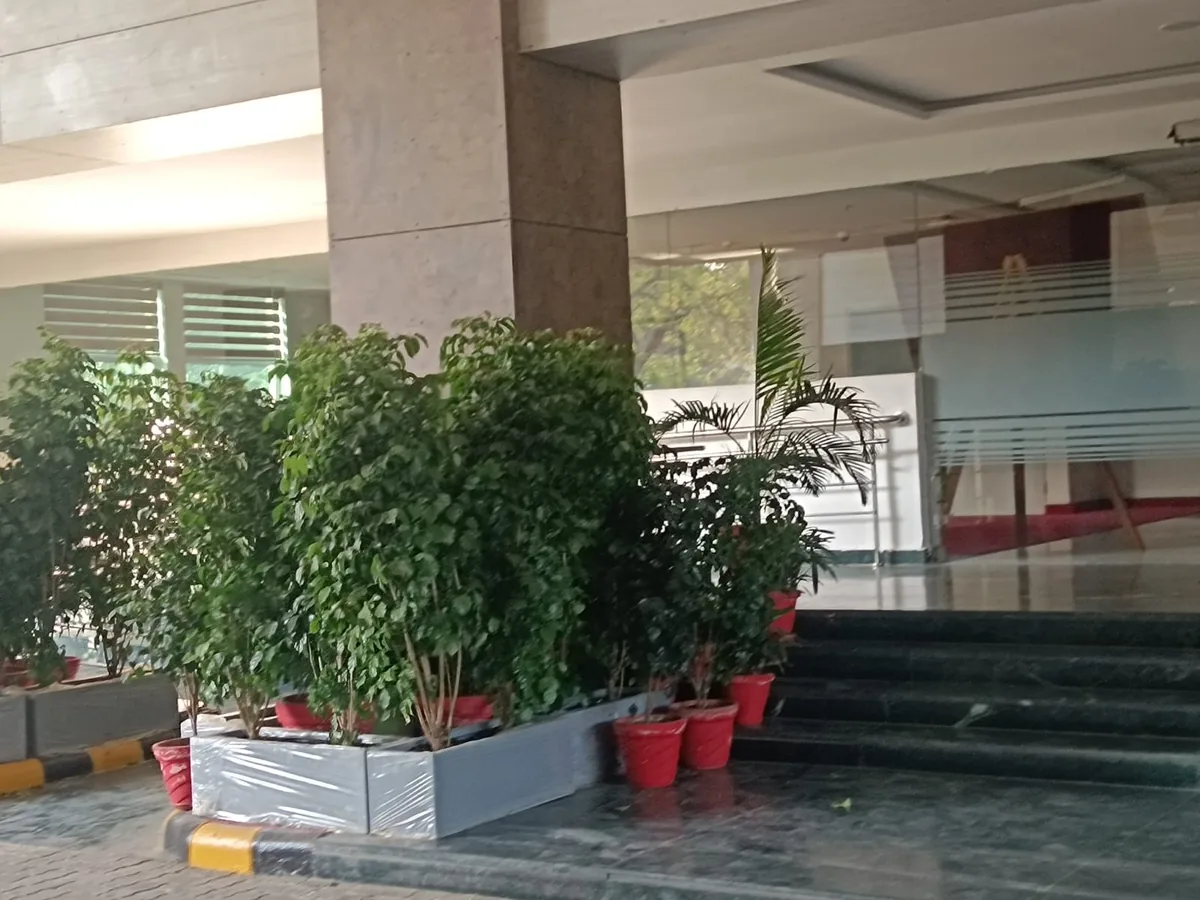
Where the ground is paved, planters do most of the work. Large box planters or rows of pots can line a driveway, frame the steps and soften pillars without digging up the floor. They can also be moved for events, repairs or security needs.
Choosing planters
- Size: bigger planters hold more soil and water, so plants dry out more slowly in summer. Small pots on a hot porch need watering far more often.
- Material: concrete, RCC, FRP and other sturdy garden planters handle knocks from trolleys and footfall better than thin plastic.
- Drainage: every planter needs drainage holes and a base layer so water does not stand on stone floors and stain them.
- Uniformity: one planter style and colour along a driveway looks orderly, which suits most official buildings.
Choosing plants for entrances
For covered porches and bright shade, broad-leaf and shade-tolerant plants such as ficus, areca palm and other foliage plants are commonly used in box planters. In full sun near gates and boundaries, hardier shrubs and seasonal flowers can add colour. Avoid thorny plants beside walkways, plants that drop a lot of litter on steps, and anything that grows tall enough to block CCTV or the guard's view.
Rajput Farms' plant installation service covers planting for garden and landscape projects, so plants and planters can be set out as one job.
Planning an institutional campus garden beyond the entrance
Larger campuses usually have open ground as well: lawns in front of the main block, a boundary strip, parking edges and courtyards. A simple layout works well:
- A neat lawn or ground cover in front of the main building, with a clear edge along paths.
- Hedges or shrub rows to separate parking from pedestrian areas.
- Shade trees set back from buildings, drains and underground cables, placed where they will shade parking or seating as they grow.
- Seating areas or small courtyards only where staff or visitors will actually use them.
For campus-scale work, Rajput Farms offers institutional landscaping for schools, colleges and institutional campuses.
Watering without daily headaches
Most government building gardens fail not at planting but in the first summer, when watering slips. Plan it before planting:
- Group plants by water need, so thirsty plants are not mixed with dry-tolerant ones.
- Use mulch on open beds to slow evaporation.
- Where planters or beds are many, a drip irrigation line with a simple timer cuts the daily load on staff.
- Keep a tap or hose point near the entrance planters for manual top-up in peak heat.
Maintenance: agree it before you plant
An official entrance has to look tidy every working day. A written maintenance plan avoids the slow decline that many campus gardens show after a few months:
- Weekly: watering checks, removing dry leaves, clearing litter from planters and sweeping soil off the floor.
- Monthly: light pruning, checking for pests, and replacing any plant that has died or become weak.
- Seasonally: feeding, refreshing soil in planters, and preparing for the monsoon and peak summer.
If you do not have an in-house team, a landscape AMC (annual maintenance contract) covers ongoing upkeep of landscaped property.
How to brief a landscaping contractor
When you invite quotations, a clear brief gets comparable answers:
- Site location, a rough sketch or photos of the entrance, driveway and open areas.
- Which areas are covered and which are in full sun.
- The look you want: formal and uniform, or softer and more varied.
- Whether planters are needed, and how many spots.
- Whether maintenance should be included, and for how long.
- Any rules on height, security sightlines or event use of the forecourt.
A project example from Lucknow
Rajput Farms has carried out government building landscaping at Pratyaksh Kar Bhawan in Hazratganj, Lucknow. The project page shows the entrance, porch and covered driveway lined with potted plants, including ficus in box planters and areca palms beside the steps. Lucknow is listed as a service area on our Lucknow page.
What does it cost?
Rajput Farms does not publish fixed prices online. Cost depends on the size of the site, the number and type of planters, the plants chosen, irrigation and whether maintenance is included, so each project is quoted from your site details.
Frequently asked questions
What is government building landscaping?
It is the planning, planting and upkeep of green areas at government offices and campuses, usually focused on the entrance, porch, driveway, front lawn and boundary strips, with planters wherever the ground is paved.
Which plants suit a covered office entrance?
Shade-tolerant foliage plants such as ficus and areca palm are commonly used in box planters under porches. Keep thorny or litter-heavy plants away from walkways, and keep plants low enough not to block CCTV or guard sightlines.
Are planters better than beds for public buildings?
On paved entrances, yes. Planters add greenery without digging up the floor, can be moved for events or repairs, and keep soil off stone surfaces. Open beds and lawns suit areas with natural soil.
How often should entrance plants be maintained?
Watering and tidying need weekly checks, pruning and replacement of weak plants roughly monthly, and soil and feeding seasonally. An annual maintenance contract is a common way to keep this regular.
Has Rajput Farms landscaped a government building?
Yes. Rajput Farms' projects include Pratyaksh Kar Bhawan in Hazratganj, Lucknow, listed on the site as government building landscaping.
Plan your building's landscaping with us
Share your site location, a few photos of the entrance and open areas, and whether you need maintenance, through the contact page. For landscaping projects, call or WhatsApp +91 88087 69257.