
Industrial Boundary Wall: Precast Options for Factories
How to plan an industrial boundary wall: precast RCC panels vs fencing, gates, drainage, barbed wire toppings and space for a green belt on factory sites.
By Rajput Farms · 2026-10-21
An industrial boundary wall is the secure perimeter around a factory, warehouse or plant. Precast RCC walls suit most industrial sites because panels are factory-cast and assembled quickly on site. Plan the survey, gates, drainage, a barbed wire or fencing topping where risk is high, and space for a green belt before ordering.
What an industrial boundary wall has to do
A factory boundary wall is more than a property line. It controls who and what enters the site, screens stores and yards from the road, keeps stray animals out, and gives security staff a clear perimeter to watch. On many industrial plots it also has to cope with heavy trucks moving close to it, monsoon runoff from large paved areas, and later expansion of sheds and parking.
Because of this, an industrial boundary wall is planned edge by edge. The road frontage, the main gate, the side boundaries next to other units and the rear edge next to open land often need different heights, toppings and gates.
Precast RCC wall, brick wall or fencing?
Precast RCC boundary wall
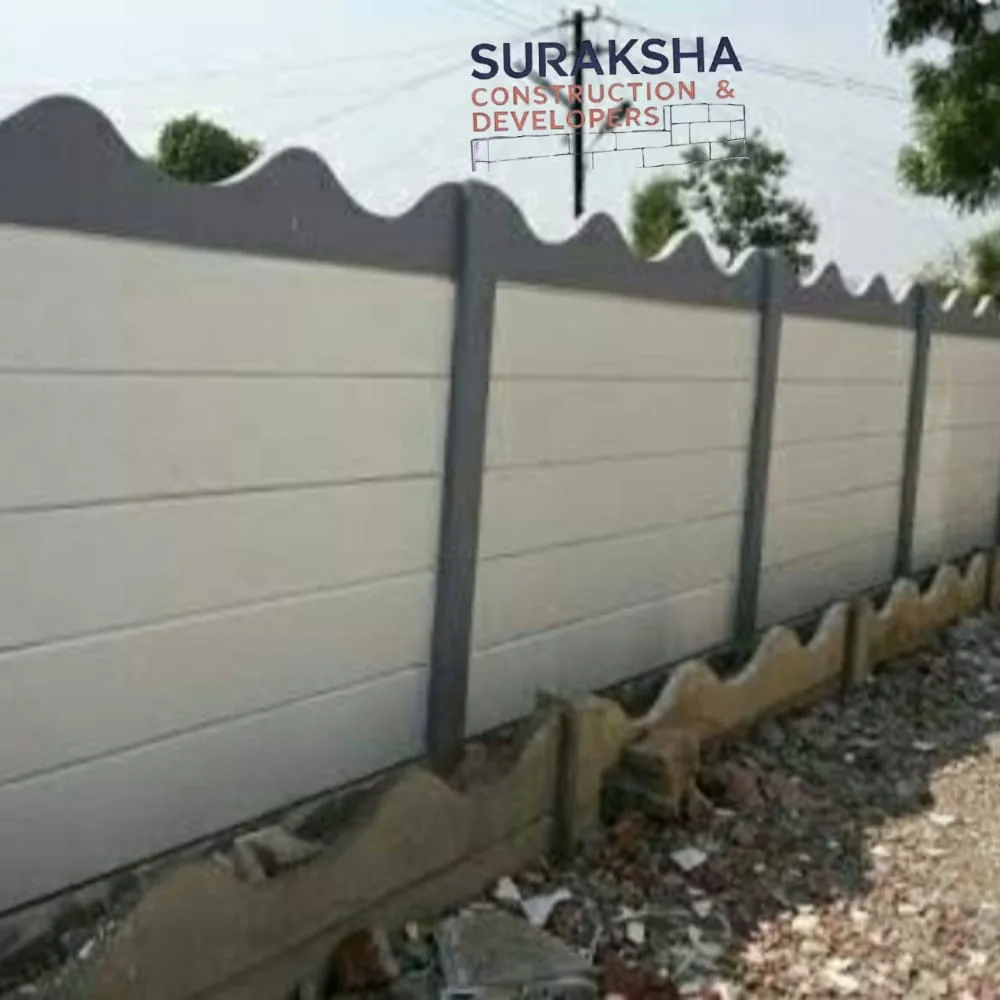
A precast wall uses concrete panels and posts that are cast in a factory, transported to site and slotted together. A brick wall is built on site and needs curing time before it is ready, while precast panels are simply assembled, which cuts on-site construction time a lot. That matters on a working plant where you want the perimeter closed quickly and with little disruption. Factory casting also keeps the finish consistent along a long boundary. For a general comparison, see our guide on choosing the right precast boundary wall.
Chain link or barbed wire fencing
For long rear or side edges, fencing on posts marks the boundary at a lower cost per running length and keeps air and light moving. For industrial sites, GI chain link or PVC-coated chain link are common because they resist rust and weather in continuous use. Our industrial fencing service covers these layouts.
A combined perimeter
Most factories end up with a mix: a solid precast wall along the road and around higher-security zones such as stores, and fencing on lower-risk edges. Industrial fencing and boundary wall installation can be combined on the same site.
Planning a factory compound wall: a checklist
- Survey and demarcation: get the plot measured and the corners fixed against your sale deed or lease map before any post goes in. Settle any doubtful edge with neighbouring units first.
- Gates and vehicle movement: mark the main truck gate, a separate staff or visitor gate if you need one, and any emergency exit. Leave enough width and turning space for the longest vehicle that will use each gate, and keep the wall clear of truck swing paths.
- Security zones: decide which edges need a taller solid wall, which need a topping, and where a guard post or security cabin will sit near the gate.
- Drainage: large roofs and paved yards send a lot of water to the boundary in the monsoon. Mark low spots and existing drains, and plan openings, culverts or a drain line so the wall does not trap water inside the site.
- Utilities and approvals: check for underground cables, pipelines and drains along the line, and confirm any setback or height rules that your industrial area or local authority applies.
- Future expansion: if more sheds or parking are planned, place gates and the wall line so they still work after expansion.
- Delivery access: precast panels come by truck, so check that vehicles can reach the boundary line, especially on soft ground in the rains.
Boundary wall with barbed wire or a fencing topping
Where the risk of intrusion is higher, a topping on the wall adds height and makes climbing harder. Chain link jali, barbed wire or RCC fencing poles can be added on top of or alongside a precast boundary wall for extra security. A boundary wall with barbed wire is common along road frontages and around stores, while inner edges between your own blocks may not need it. Keep toppings in good repair, because loose or broken wire can be a hazard for staff.
How precast installation works
Rajput Farms' boundary wall installation service covers site measurement, post fixing, transport of precast panels to your site, panel installation between posts, and finishing and handover. The panels and posts are made by our precast division, Suraksha Construction, at the precast factory in Chahania, Chandauli in the Varanasi region, and manufacturing is part of the same service.
Because the parts are cast off site, the work does not depend on masons, curing time or a steady water supply at your plant. That keeps the boundary job short and limits the mess and noise near running operations.
Leave space for a green belt
Many industrial plots also need a green belt or perimeter planting inside the wall. It is much easier to plan this at the same time as the wall than to squeeze it in later.
- Leave a planting strip a short distance in from the wall, with an access path for inspection and drainage work.
- Keep large, deep-rooted trees back from the wall line so roots do not push against posts or footings over time.
- Plan where irrigation lines will run so they do not cross gates or drains.
Rajput Farms also provides industrial landscaping, so the wall and the planting inside it can be planned together.
Upkeep through the year
Precast walls need little routine care, but a short seasonal check helps:
- Before the monsoon: clear drainage openings and culverts, and remove scrap or material stacked against the wall.
- After the monsoon: check for soil washed away at the base of posts and refill it.
- Through the year: inspect joints, coping, gates and any wire topping, and repair damage from vehicles quickly.
What affects the cost?
Rajput Farms does not publish a fixed per-foot rate. Cost depends on wall length, wall height, site condition and transport distance, so share your site details for a quotation. For industrial fencing, the areas listed are Kanpur, Lucknow, Varanasi and the Gurugram, Delhi-NCR, Noida and Greater Noida corridor. For boundary wall installation, contact us to confirm availability at your location.
Frequently asked questions
Is a precast wall suitable for a factory boundary?
Yes, for most factory sites. Precast RCC panels and posts are cast in a factory and assembled on site, so the perimeter closes faster than a brick wall that needs on-site curing, and the finish stays consistent along a long boundary.
Can barbed wire be added on top of a precast boundary wall?
Yes. Chain link jali, barbed wire or RCC fencing poles can be added on top of or alongside a precast boundary wall for extra security, usually on road frontages and around higher-risk zones.
Should a factory use a wall or fencing?
Many factories use both: a solid precast wall on the road side and around stores, and GI or PVC-coated chain link fencing on lower-risk rear and side edges. Industrial fencing and boundary wall installation can be combined on one site.
What does Rajput Farms' boundary wall installation include?
It covers site measurement, post fixing, transport of precast panels to your site, panel installation between posts, and finishing and handover. Panels and posts are made by Suraksha Construction, the company's precast division, in Chahania, Chandauli.
How much does an industrial boundary wall cost?
Cost depends on wall length, wall height, site condition and transport distance. Rajput Farms does not publish a fixed per-foot rate and quotes each project from your site details.
Plan your industrial boundary with us
Share your site location, the approximate boundary length and a few photos through the contact page. For precast walls, call +91 63895 33863. For combined wall, fencing and landscaping projects, call or WhatsApp +91 88087 69257.