Miyawaki Plant Species: Choosing Native Trees for UP
Native Miyawaki plant species for Uttar Pradesh by layer, which plantation trees to leave out, how to match species to a site and check sapling quality.
By Rajput Farms · 2026-10-28
The right Miyawaki plant species are trees and shrubs native to your own region, mixed across four layers: canopy trees, trees, sub-trees and shrubs. In Uttar Pradesh that usually means species such as peepal, jamun, neem, arjun, mahua, bel and karonda, planted densely and in variety, with exotics and invasives left out.
Why species choice decides a Miyawaki forest
The Miyawaki method plants many native saplings close together so they compete for light and grow quickly into a dense, layered forest. That only works when the plants belong to the local climate and soil. Native species are already adapted to the heat, monsoon and dry winter of the region, need far less care once established, and support local birds and insects.
A poor species list is one of the most common reasons a dense plantation thins out after two or three years. This guide explains how to build a sensible list for Uttar Pradesh. For the full service, see our Miyawaki forest development page.
The four layers of a Miyawaki forest
Most Miyawaki designs sort species into four layers by their final height, and plant them mixed together rather than in rows:
- Canopy layer: the tallest, long-lived trees that will form the roof of the forest.
- Tree layer: medium-tall trees that fill in below the canopy.
- Sub-tree layer: smaller trees that tolerate partial shade.
- Shrub layer: woody shrubs that cover the ground and close gaps at the edges.
A good list includes several species in every layer, so the forest stays dense even if one species struggles. Planners usually aim for wide variety rather than a few favourites.
Native trees for Miyawaki in UP
The species below are widely grown across the Gangetic plains and are common choices for dense plantation in Uttar Pradesh. Always check them against your own site's soil and water.
Canopy and tree layer
- Peepal (Ficus religiosa) and bargad (Ficus benghalensis): large, long-lived figs that feed many birds.
- Pilkhan (Ficus virens) and gular (Ficus racemosa): hardy native figs.
- Neem (Azadirachta indica): tolerant of heat and poor soil.
- Jamun (Syzygium cumini): dense evergreen crown and fruit for wildlife.
- Mahua (Madhuca longifolia) and arjun (Terminalia arjuna): strong native trees; arjun suits moist ground near drains.
- Sheesham (Dalbergia sissoo) and kadamb (Neolamarckia cadamba): fast early growth.
- Semal (Bombax ceiba): tall, with red flowers in late winter.
Sub-tree layer
- Bel (Aegle marmelos) and amla (Phyllanthus emblica): hardy, useful native fruit trees.
- Amaltas (Cassia fistula), palash (Butea monosperma) and kachnar (Bauhinia variegata): flowering native trees that handle dry spells.
- Sehjan (Moringa oleifera): quick-growing and light-crowned.
Shrub layer
- Karonda (Carissa carandas): thorny, drought-hardy and good for edges.
- Adusa (Justicia adhatoda) and harsingar (Nyctanthes arbor-tristis): native shrubs that cope with partial shade.
- Kaner (oleander) and mehndi (Lawsonia inermis): tough shrubs for dry, exposed edges.
These are examples, not a fixed formula. Rajput Farms supplies Miyawaki plants, native plants and forestry plants for plantation projects, and the final list is matched to each site.
Species to leave out
Dense plantation species should be native, so some popular plantation trees do not belong in a Miyawaki forest:
- Eucalyptus and poplar: useful timber crops, but non-native and thirsty.
- Subabul (Leucaena) and vilayati babool (Prosopis juliflora): spread aggressively and crowd out native plants.
- Ornamental exotics such as many palms and imported flowering trees, which add little to a native forest.
- Weedy invasives such as lantana and parthenium, which should be cleared from the site before planting.
Matching species to your site
A list that works in Kanpur may need changes in a waterlogged plot in Unnao or a dry, rocky site further south. Before finalising species, check:
- Soil: heavy clay, sandy or alkaline (usar) soil each favour different trees. Soil preparation with compost and mulch matters as much as species.
- Water: low-lying spots suit arjun and jamun; dry, exposed spots suit neem, palash and karonda.
- Sunlight and space: the edges get more sun and wind than the middle, so put the hardiest shrubs there.
- Purpose: a school, factory or housing society may want flowering or fruiting species near paths, and denser thorny shrubs along a boundary.
For factory sites, our factory green belt guide covers perimeter planting alongside dense forest patches.
Checking sapling quality
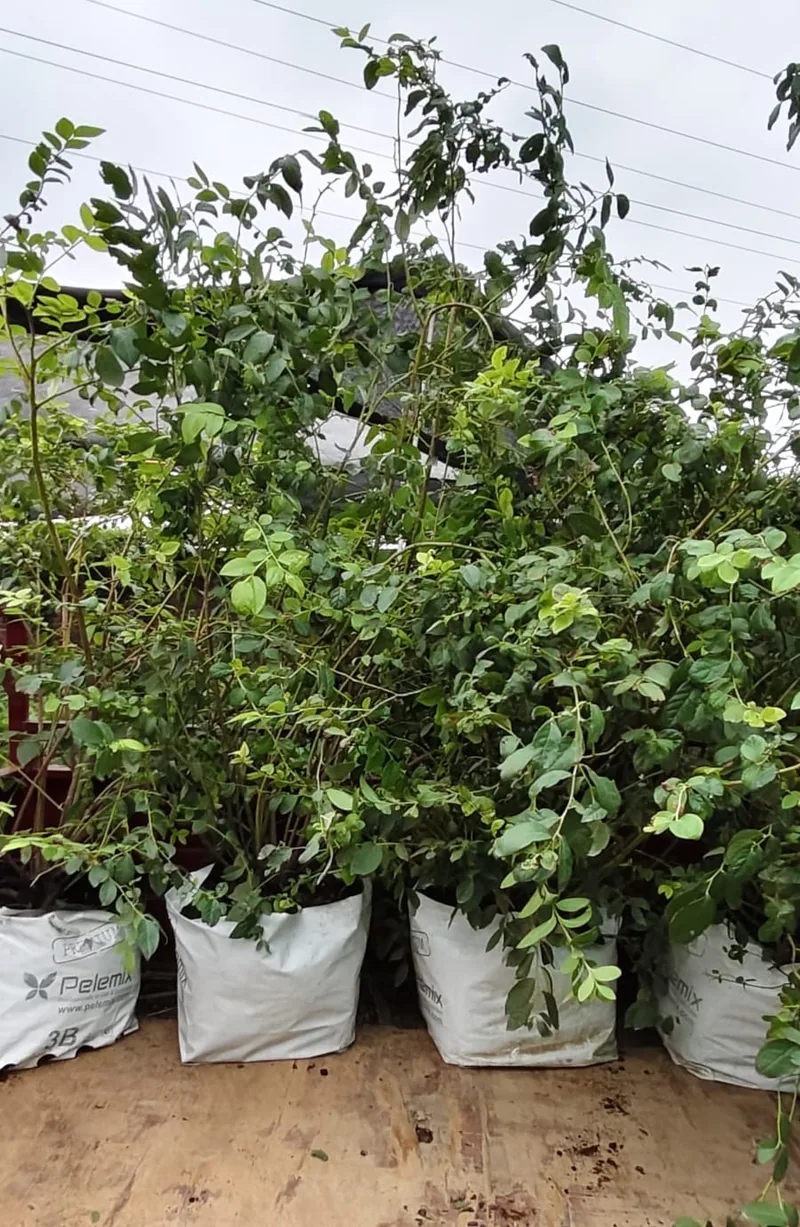
Good species can still fail if the saplings are weak. When sourcing native forest development plants, look for:
- Saplings grown in bags or pots, with a firm root ball that holds together when lifted.
- Healthy, unwilted leaves and no signs of pests or disease.
- A sensible size, usually young saplings rather than large trees, which establish better in dense planting.
- Correct names. Ask for both the local and botanical name, since local names vary between districts.
- Enough stock of every species, so the mix is not quietly replaced by whatever is easy to supply.
Rajput Farms handles plantation plant supply for projects and runs a plant nursery in Chakeri, Kanpur.
Care after planting
A Miyawaki forest needs regular watering, weeding and mulching for roughly its first two to three years, until the canopy closes and the forest can look after itself. Replacing failed saplings with the same layer and species keeps the design intact. See plantation irrigation and plantation maintenance for support during this period.
A real example
Rajput Farms' project list includes an approximately 3-acre native-species Miyawaki forest in Unnao, Uttar Pradesh. For larger tree-cover work beyond a dense micro-forest, see our afforestation service.
How is the price worked out?
Rajput Farms does not list fixed prices online. A quote for a Miyawaki plantation depends on the area, the species mix and number of saplings, soil preparation, irrigation and the maintenance period, so it is prepared after the site details have been reviewed.
Frequently asked questions
Which plant species are used in a Miyawaki forest?
Species native to the local region, mixed across four layers: canopy trees, trees, sub-trees and shrubs. In Uttar Pradesh common choices include peepal, bargad, neem, jamun, arjun, mahua, bel, amla, palash and shrubs such as karonda and adusa.
How many species should a Miyawaki forest have?
There is no fixed number, but a good design uses several species in every layer and favours wide variety over a few favourites. Variety keeps the forest dense even if one species struggles on the site.
Can eucalyptus or poplar be used in a Miyawaki forest?
They are not suitable. The Miyawaki method relies on native species, and eucalyptus and poplar are non-native plantation trees. Invasive species such as subabul and vilayati babool should also be avoided.
Are fruit trees allowed in a Miyawaki plantation?
Native fruit trees such as jamun, bel, amla and karonda fit well and feed birds and insects. Exotic or grafted orchard varieties are better kept in a separate orchard.
Does Rajput Farms supply saplings for Miyawaki forests?
Yes. Rajput Farms supplies Miyawaki plants and native plants for plantation projects, and its project list includes an approximately 3-acre native-species Miyawaki forest in Unnao, Uttar Pradesh.
Plan your Miyawaki forest
Share your site's location, area, soil type and water source through the contact page. For Miyawaki forests, plantation projects and bulk sapling supply, call or WhatsApp +91 88087 69257.