Corporate Miyawaki Forest: How a Micro-Forest Is Planned
How companies plan a corporate Miyawaki forest: goals, site checks, deep soil preparation, layered native species, dense planting, care and records.
By Rajput Farms · 2026-11-05
A corporate Miyawaki forest is a dense native-species forest planted on company land. Planning covers five steps: set clear goals, choose a suitable plot, prepare the soil deeply, plant a mix of native saplings close together, and fund two to three years of watering, weeding and replacement until the canopy closes and the forest can stand on its own.
What a corporate Miyawaki forest is
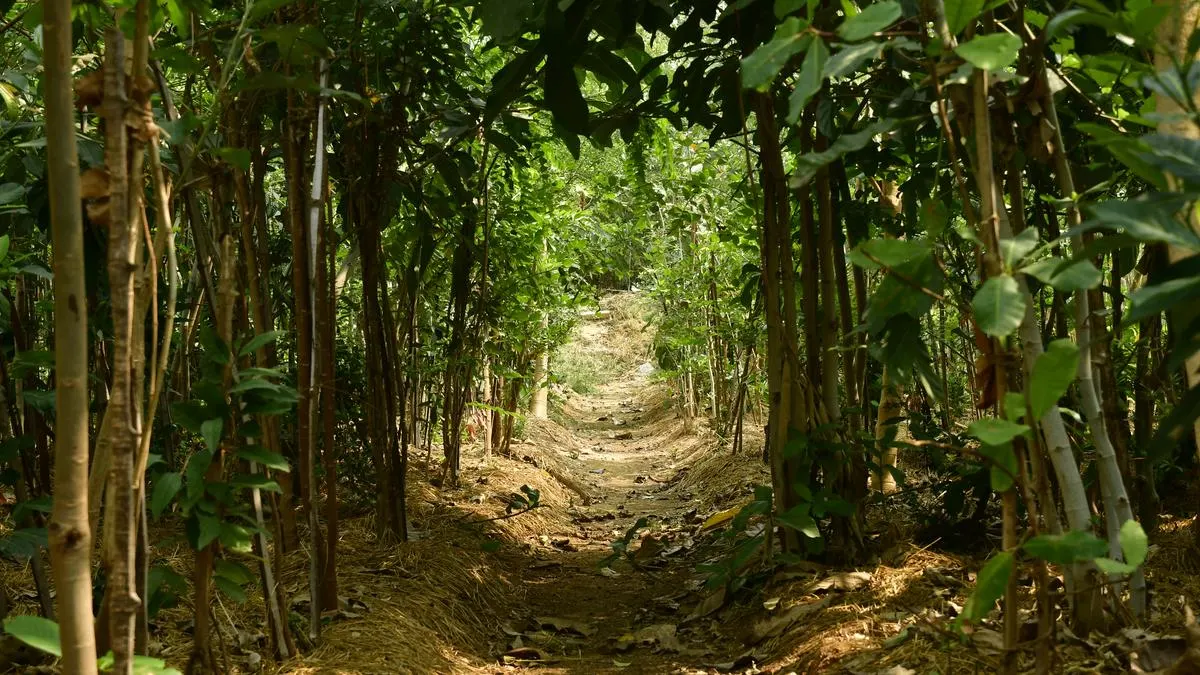
The Miyawaki method, developed by Japanese botanist Akira Miyawaki, plants many native species close together on well-prepared soil so that they grow into a multi-layered forest. A Miyawaki micro forest can fit on a small plot, which is why factories, offices, warehouses and institutional campuses use it on spare land, along boundaries or in unused corners.
A corporate Miyawaki forest is the same method run as a company project, usually with a sponsor inside the organisation, a fixed budget and a reporting need. That difference changes how the project should be planned: the work does not end on planting day, and someone has to own the forest for the next few years.
It is also different from other planting on company land:
- A green belt is a planned band of trees and shrubs along a boundary, usually in rows. See our guide to factory green belt planning.
- A tree plantation places saplings at wider spacing across a campus. See industrial tree plantation.
- A Miyawaki forest is a dense block of mixed native species meant to become self-sustaining.
Many sites use all three, each on a different part of the land.
Step 1: Set clear goals before choosing a plot
Write down why the company wants the forest. Common reasons include:
- Greening unused or degraded land inside the premises.
- Creating shade, a visual screen or a buffer near a boundary or road.
- Supporting birds, insects and local biodiversity.
- A CSR tree plantation or sustainability commitment that needs to be documented.
- An employee or community engagement activity on planting day.
The goal decides the size, the location and the kind of records you need. A visual screen near a road needs a different layout from a biodiversity patch behind a plant building. If the forest is part of a CSR programme, check internally how your company records and reports such projects; Rajput Farms does not advise on CSR compliance rules.
Step 2: Choose and check the site
A good plot for an industrial Miyawaki forest:
- Gets full sun for most of the day.
- Drains well and does not stay waterlogged after monsoon rain.
- Is safe from future construction. Avoid land marked for expansion, pipelines, cable routes or vehicle movement.
- Has a water source nearby, because young saplings need regular watering in the first years.
- Can be fenced or protected from cattle, goats and foot traffic.
Get a quick soil check done. Factory land often has compacted soil, construction debris, fill material or, in some places, salinity. These problems can be fixed, but they change the soil preparation work and should be known before the budget is fixed.
Step 3: Prepare the soil properly
Soil preparation is the step that separates a Miyawaki forest from ordinary planting. The usual approach is:
- Clear debris and weeds from the whole plot.
- Loosen the soil deeply across the area, not just in individual pits, so roots can spread.
- Add organic matter such as compost, manure or other locally available material to improve structure and water holding.
- Mark the area into planting zones so species can be mixed evenly.
Skipping or rushing this step is a common reason dense plantations struggle. It is worth giving the contractor time to do it properly.
Step 4: Pick native species in layers
A Miyawaki forest copies the layers of a natural forest: tall canopy trees, mid-height trees, smaller trees and shrubs. Species should be native to the region and suited to the local soil and rainfall, and a good mix uses many different species rather than a few.
For a detailed look at which trees suit Uttar Pradesh, read our guide to Miyawaki plant species. Rajput Farms supplies Miyawaki plants and native plants, with nursery stock from its Chakeri nursery in Kanpur.
Step 5: Plant densely and mulch
Saplings are planted close together, commonly about three to five per square metre in many Miyawaki projects, with species mixed so that no two of the same kind sit side by side. Close planting makes the saplings compete for light and grow upward, and the canopy closes sooner.
After planting:
- Mulch the whole surface with straw or dry leaves to hold moisture and suppress weeds.
- Water immediately and set up a watering routine. A simple drip irrigation line can help on larger plots.
- Fence or mark the plot so it is not trampled.
If staff are joining a planting day, plan it so the soil work is finished beforehand and volunteers only plant, mulch and water under supervision.
Step 6: Fund two to three years of care
A Miyawaki forest needs looking after until the canopy closes, often for around two to three years depending on site and species. Care usually includes:
- Regular watering, especially through the first summer.
- Weeding until the canopy shades out weeds.
- Replacing saplings that fail.
- Keeping the mulch layer topped up.
- Checking the fence and protecting the plot from animals.
After that period the forest is generally left to grow on its own with little intervention. Include this care in the original budget and contract. Plantation maintenance can be taken as an ongoing service.
Records a company may want to keep
For internal reports or a CSR file, it helps to keep simple records from the start:
- Plot location and area.
- Species list and sapling counts at planting.
- Dated photos at planting and at regular intervals.
- Replacements made during the care period.
- Watering and maintenance logs.
Ask your contractor which of these records they will hand over, and how often.
Questions to ask a Miyawaki forest contractor
- Have you planted a Miyawaki forest before, and can we see it?
- How will you check and prepare our soil?
- Which native species do you propose, and where will saplings come from?
- What planting density and layout do you suggest for our plot?
- What does the maintenance period include, and for how long?
- How do you handle sapling replacement?
- What records and photos will you share with us?
How Rajput Farms plans corporate Miyawaki forests
Rajput Farms & Green Infra Pvt. Ltd. has worked on landscape and plantation projects since the 1980s (40+ years). Its projects include an approximately 3-acre native-species Miyawaki forest in Unnao, and Miyawaki forest development is offered as a service alongside industrial landscaping, corporate landscaping, afforestation and commercial tree plantation.
Service areas listed for Miyawaki forest development include Varanasi, Chandauli, Gurugram and Delhi-NCR, with Kanpur as the home base. Pricing is quoted per project after the site and requirements are understood; no fixed prices are published.
Frequently asked questions
What is a corporate Miyawaki forest?
It is a small, dense forest of mixed native species planted on company land using the Miyawaki method. Companies use it to green unused land, create shade or screening, support biodiversity or meet a sustainability or CSR tree plantation commitment.
How much land is needed for a Miyawaki forest?
A Miyawaki micro forest can be planted on a fairly small plot, which is why it suits factory and office campuses. The right size depends on your goal, budget and available land. Larger areas are also possible; Rajput Farms' projects include an approximately 3-acre Miyawaki forest in Unnao.
How long does a Miyawaki forest need maintenance?
Usually around two to three years, until the canopy closes. During that time it needs regular watering, weeding, mulching and replacement of failed saplings. After that the forest is generally left to grow with little intervention.
Is a Miyawaki forest the same as a green belt?
No. A green belt is usually a band of trees and shrubs planted along a boundary, often in rows. A Miyawaki forest is a dense block of many native species planted close together to grow into a multi-layered forest. Many industrial sites use both.
Does Rajput Farms develop Miyawaki forests for companies?
Yes. Rajput Farms offers Miyawaki forest development, including site and soil preparation, native saplings and maintenance. Listed service areas include Varanasi, Chandauli, Gurugram and Delhi-NCR. Call or WhatsApp +91 88087 69257; pricing is quoted per project.
Plan a Miyawaki forest on your premises
Share your site location, the approximate area available, your goal for the forest and a few photos of the plot through the contact page, or call or WhatsApp +91 88087 69257.